

This is part 3 of answering the question: What makes cooperation so valuable?
One Takeaway
Even if you’re great at everything, you’re better off focusing on what you do best, and letting others do the rest.
Why Not Just Do It All Yourself?
You may be the most capable person on your team, in your family, or at your company. But being the best at everything doesn’t mean you should do everything. Economists call this idea comparative advantage.
It’s one of the most powerful ideas in economics. It’s all about how we work with each other. Comparative advantage shows that even if one person is better at everything, two people working together can still achieve more by focusing on what each does relatively better.
A Simple Example
Imagine you and your kid are tackling two garden tasks: pulling weeds and planting rose bushes. Neither of you wants to spend more time than necessary on these chores. You’re faster at both. But, that doesn’t mean you should do both.
Let’s say you can pull 25 weeds in the same time it takes your kid to pull 12. You also can plant 5 rose bushes in the same time your kid plants 4.
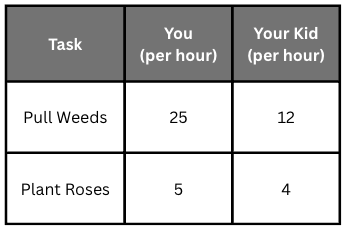
If you spend one hour planting roses, you give up the chance to pull 25 weeds. Your kid only gives up 12 weeds in the same situation. That’s a smaller sacrifice. So while you’re better at both tasks, it costs you more (in terms of weeds) to plant roses than it costs your kid.
This means your time is relatively better spent pulling weeds, and your kid’s time is relatively better spent planting roses. If each of you specializes based on comparative advantage and then cooperates, you get more chores done in the same amount of time.
Why It Works
Comparative advantage isn’t about being the best. It’s about what you give up when you choose to do one task instead of another (your opportunity cost). If your opportunity cost is higher, it makes sense to let someone else take the lead. This is true even if you could technically do it faster.
This idea shows up everywhere.
A CEO may have a knack for graphic design, but they’ll likely create more value focusing on strategy and hiring others to design.
A brilliant surgeon could also be a good administrator, but they save more lives by spending time in the operating room and hiring an office manager.
Tom Brady may have been great at taping up ankles before a game, but the he probably scored more points because he spent time warming up instead and left the taping to the trainers.
Even someone less skilled overall still has something valuable to contribute when they focus on where their trade-offs are smallest.
The Big Idea Behind Cooperation
Comparative advantage is one of the secrets behind why trade is so beneficial. If we all tried to do everything ourselves, we’d be less productive, more stressed, and far less wealthy.
Instead:
We specialize in what we’re relatively good at.
We exchange what we produce for what others produce.
We all end up better off, even if some of us could do both jobs on our own.
In short, we create more value together than we ever could alone.
The Bottom Line
You don’t have to be the best at everything to be valuable, and trying to do it all yourself is usually a bad idea. Comparative advantage shows us that productivity and progress come from smart trade-offs, focused effort, and mutual work. We do better by doing less—together.